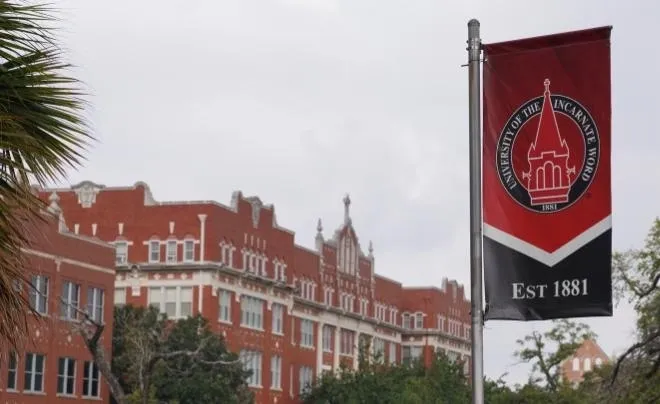

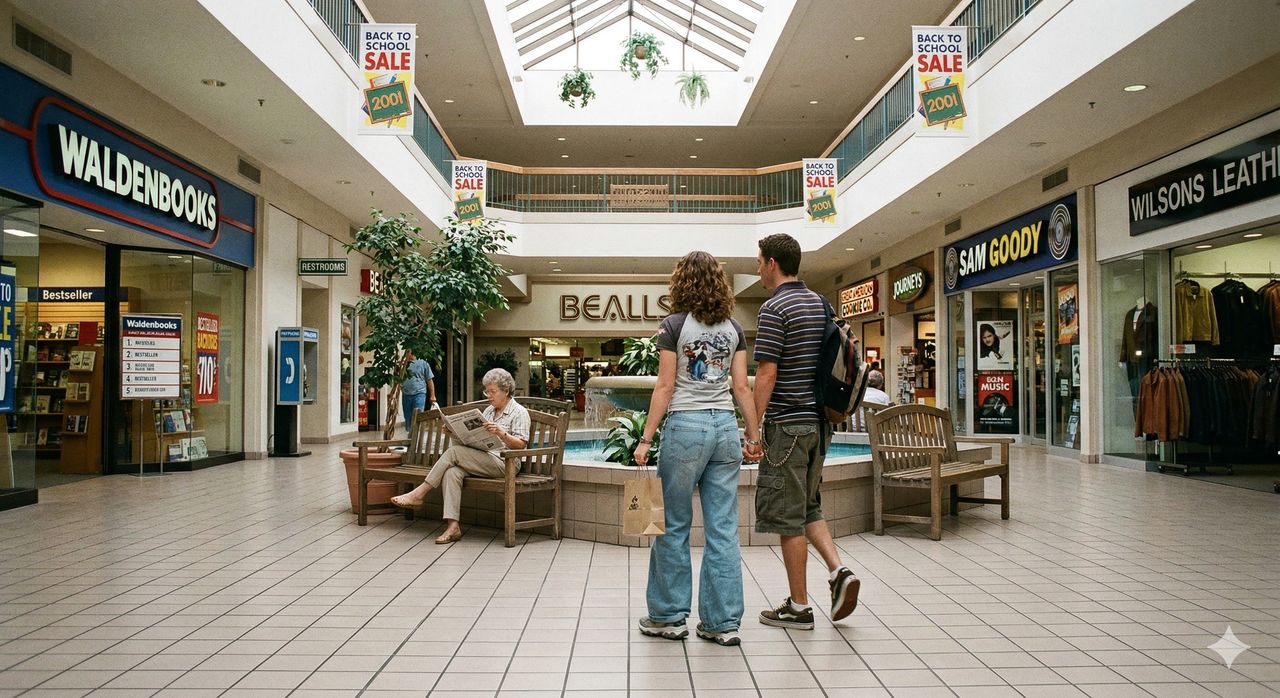
There is a specific scent that comes to mind when I ponder America circa 2001: a heady, chaotic blend of industrial leather cleaner, men’s cologne, and freshly printed mass-market paperbacks. To some, it’s just nostalgia; to me, it was the smell of my first paycheck.
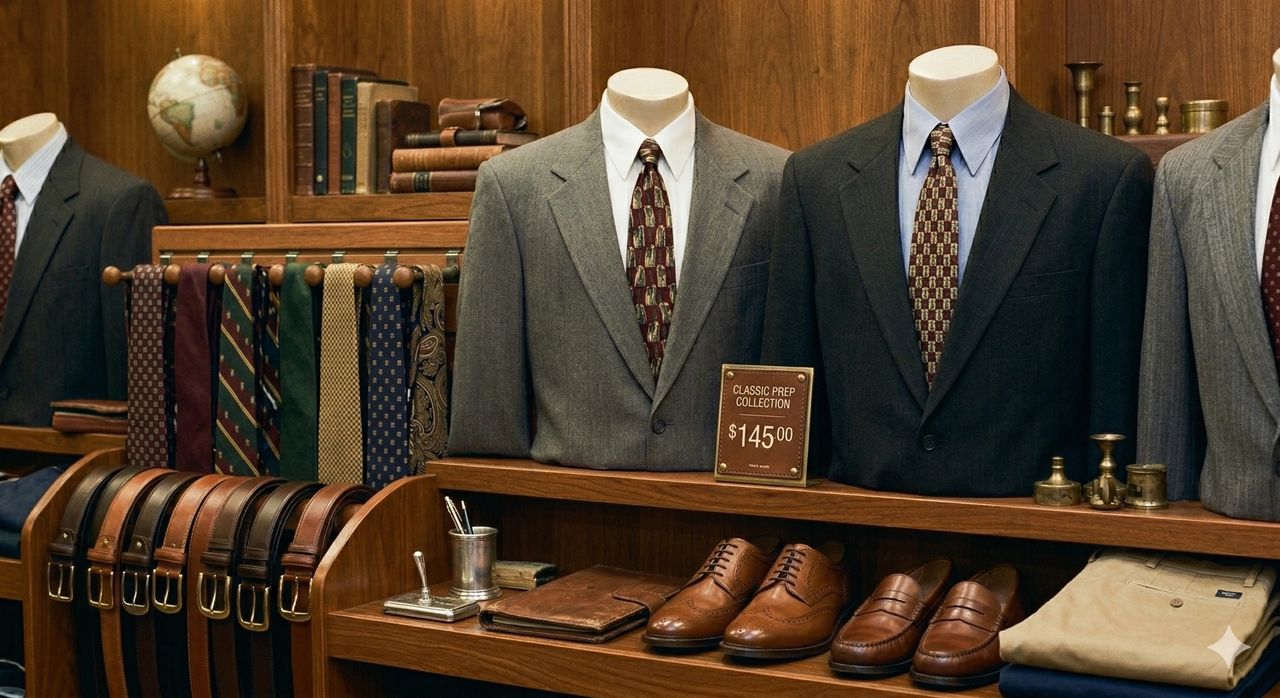
Between 2000 and 2002, the only mall in my hometown wasn’t just a place to hang out—it was the beginning of my professional ecosystem. The same mall where I once had the childhood thrill of spending the night with my Girl Scout Troop had transformed into the place where I became a retail chameleon. I moved from the stacks of Waldenbooks to the racks of Bealls, and finally to the sophisticated coat section at a Wilson’s Leather holiday pop-up. I still remember the scripted greeting that became second nature: “Good afternoon, Bealls Men’s Department, how can I help you?”
My longest tenure was at Waldenbooks, where I worked a steady 4 PM to 9 PM shift for eight months. It was here that I learned the manual labor of the mind: curating bestsellers, looking up titles by ISBN, and neatly organizing the glossy icons of the era—Vogue, GQ, Seventeen, Rolling Stone, and Maxim. At the time, the $5.25 minimum wage felt like a fortune because I had a singular, shimmering goal: a $500 prom dress I’d seen on display and fell in love with at first sight. I remember the math clearly. It took nearly 100 hours of alphabetizing Harry Potter, The Lord of the Rings, and Dr. Seuss, suggesting Oprah Book Club picks, and managing special orders to afford that dress. It was a physical manifestation of my labor.
For a long time, the narrative was that the mall was dead, killed by the efficiency of one-click ordering. But as we look at the data in 2026, a strange thing is happening: the mall is making a massive comeback, and it’s being led by a generation that never knew the glory of a KB Toys.
The Great Teen Labor Reset (1980–Today)
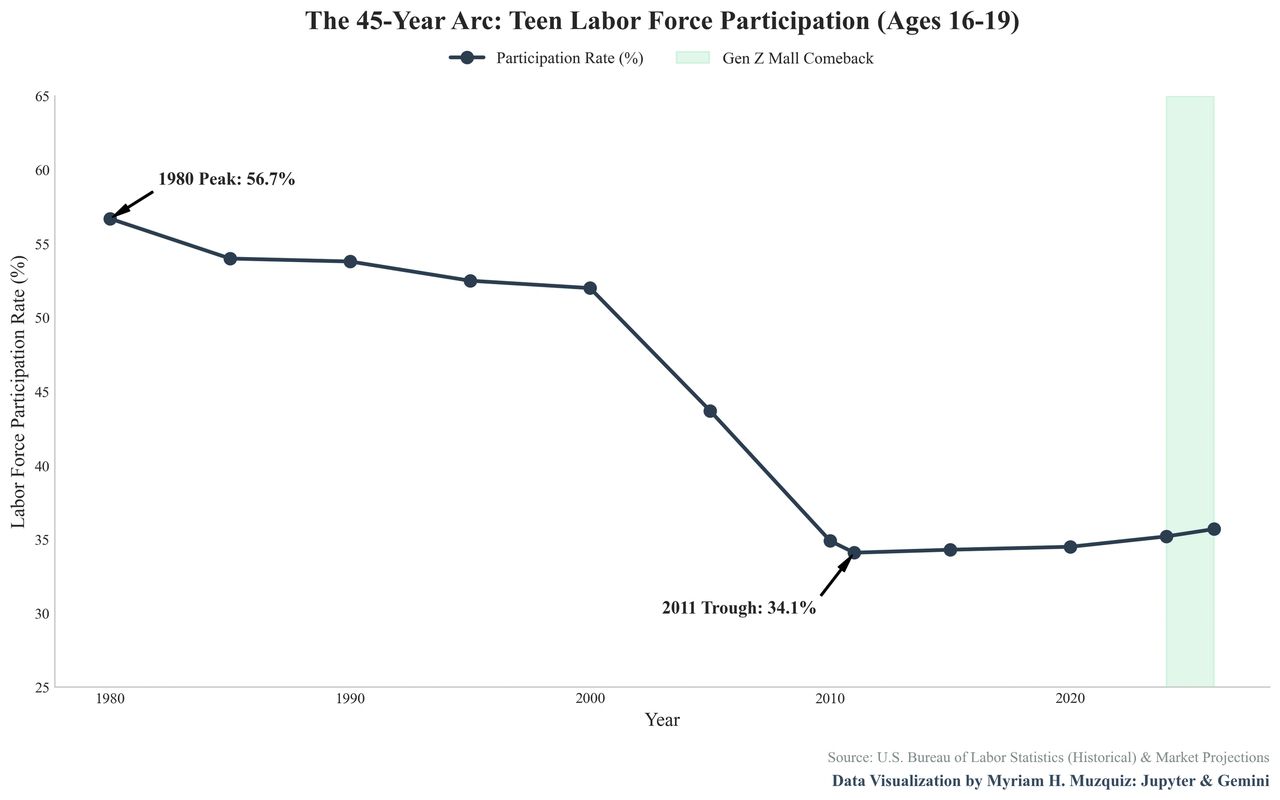
When I was working at the mall in 2001, I was part of the majority. In 1979, teen labor participation hit an all-time peak of 57.9%. By the time I started, it was still a robust 52%. We were the “Mall Generation”—the essential workforce that kept the retail engines humming.
Then, the floor fell out. By 2011, participation had plummeted to 34.1%. A mix of the Great Recession and a societal shift toward hyper-competitive college prep meant the “summer job” was replaced by “summer internships.” But as of early 2026, we are seeing a resilient stabilization at 35.7%. The teen worker isn’t extinct; they’ve just become more intentional.
The “Instant Gratification” Pivot
The return to the mall in 2026 isn’t just about teens wanting a place to hang out; it’s a massive behavioral shift in how we value time vs. convenience.
For a decade, the narrative was that e-commerce would win because it was “easier.” But as a data analyst, I look at the friction points. Shipping delays, “package porch pirates,” and the frustrating gap between seeing an item on a screen and actually feeling the texture of the fabric have created a new kind of consumer fatigue.
The Showrooming Effect
Gen Z has mastered the art of the ‘Reverse Showroom.’ They discover the trend on TikTok, but they return to the mall to validate the quality. When I worked at Wilson’s Leather and Beall’s, I saw this in its analog form: a customer would feel ten different leather jackets, or an executive would stand before me trying on suits and ties, seeking my validation on fit and style. They weren’t just buying a product; they were seeking a data point to confirm their decision. In 2026, that tactile requirement is back with a vengeance.
The Generational Hand-Off
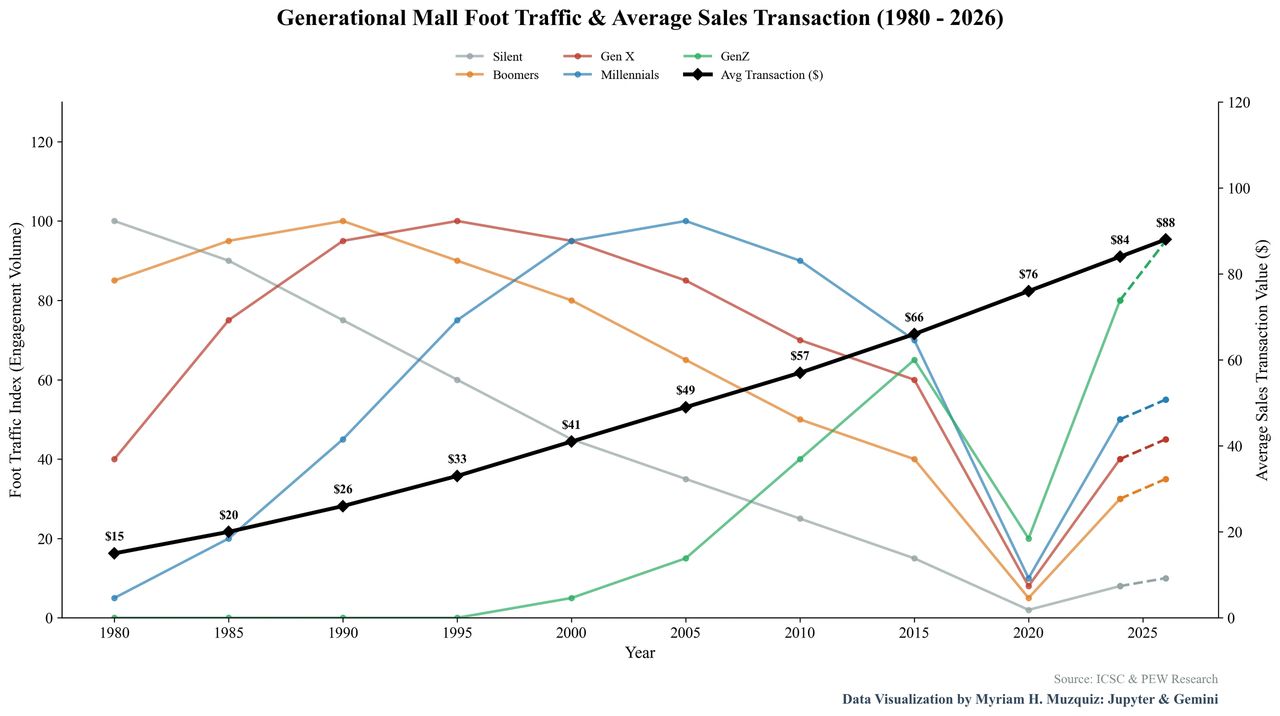
As a data analyst, I don’t just see people (fun fact, I recall in high school stating “we should never be a statistic,” yet here I am making graphs :); I see shifts in Engagement Volume. When we look at the 45-year evolution of mall foot traffic, the story isn’t about a general decline, but a passing of the baton. While the Silent Generation and Baby Boomers peaked in the 1980s and 90s, establishing the mall as the American “Third Space,” their engagement has naturally waned. However, the data reveals a striking “V-shaped” recovery led almost entirely by Gen Z. This isn’t just a return to the mall; it’s a high-value resurgence. While the Gen X “Mall Rat” era of 1995 saw the highest sheer volume of foot traffic, the 2026 landscape is vastly more lucrative. Additionally, as I was thinking of this data, I also had to add the projected Average Sales Transaction into the mix. Today at $88, compared to the inflation-adjusted equivalent of my era, the data tells us that while fewer people may be “hanging out at the mall” compared to the 90s, the ones who are high-intent shoppers are utilizing the “Reverse Showroom” to finalize major purchasing decisions – foot traffic is lower, but conversion value is at an all-time high.
Teen Workforce, The Third Space, and Final Thoughts
My journey from alphabetizing paperbacks at Waldenbooks to analyzing global operations today has come full circle, proving that the mall was never just a retail hub—it was my first training ground in Decision Intelligence. For the modern teen workforce, the mall remains the ultimate “Third Space,” a vital ecosystem where they transition from digital discovery to physical expertise. Watching this 2026 resurgence through the lens of data confirms that the tactile, high-trust environment I grew up in is still the best place to learn the texture of business. What began as a seasonal job to afford a prom dress ultimately became the foundation for a career spent navigating complex data with a human touch. As I scroll through social media and wonder what it is like to be a teenager today, I can’t help but remember that that period of time might have seemed eternal when I lived through it, but it is a small snapshot in time that requires opening the mind to young adulthood and exposing business practices at a young age.
Statistics from the Bureau of Labor Statistics show that teen labor participation has reached a 15-year high in 2026. This isn’t just a trend—it’s a generational shift toward real-world experience and financial independence.
If the mall is making a massive comeback driven by a generation that values experience over convenience, how must your own business model evolve to provide a “Third Space” for your clients?
Final note – cheers to the 2000s!
Myriam Hernández Múzquiz, MBA
Founder, Muzzi QS LLC
Data-Driven. Strategy-Led. Resilience-Proven.
Data analysis and visualizations generated via Jupyter Notebook and Matplotlib. Historical research and narrative strategy were developed in collaboration with Gemini. Data sources: U.S. Census Bureau, Bureau of Labor Statistics, and ICSC (1980-2026).