

In today’s fast-changing business environment, organizations increasingly depend on extended workforces—such as contractors, freelancers, consultants, and offshore teams—to enhance internal capabilities, expand operations, and gain access to specialized skills. While this approach offers great flexibility and cost savings, managing large-scale IT and operations projects with an extended workforce presents its own set of challenges.
As an IT business management leader, I’ve gained valuable experience navigating these complexities, especially when ensuring software compliance and optimizing processes for teams and vendors. The lessons learned from high-volume IT operations settings have been crucial in shaping my strategies for digital transformation and operational excellence. This article shares key insights on strategies for success and pitfalls to avoid. Without a clear framework and proactive management, what initially promises efficiency can quickly turn into miscommunication and missed deadlines. In my experience, a clear framework is the only antidote. While the article uses U.S. extended workforce statistics as numerical evidence, the strategic framework outlined for managing this specific type of workforce is applicable across local, national, and global scenarios.
The extended workforce in the U.S.
The “extended workforce” is defined as non-employee labor, including temps and contractors, and is a deeply established part of the economy. While it feels like a recent trend, the U.S. Bureau of Labor Statistics (BLS) has been tracking this since 1995, when “alternative employment arrangements” already accounted for 10.7% of the U.S. workforce. That figure has remained stable (at 10.1% in 2017) for every 10 people in the entire U.S. workforce, 1 of them is an independent contractor, temp worker, or on-call worker. According to industry-specific data from Staffing Industry Analysts (SIA), the extended workforce averages 21% of the total headcount at large enterprises, closer to 1 out of every 5 colleagues (or 2 out of 10).
As illustrated in Figure 1, this means that large-scale organizations are leveraging non-employee talent at more than double the rate of the national average.
Figure 1
Workforce Averages – Extended vs. FTE Employment Split
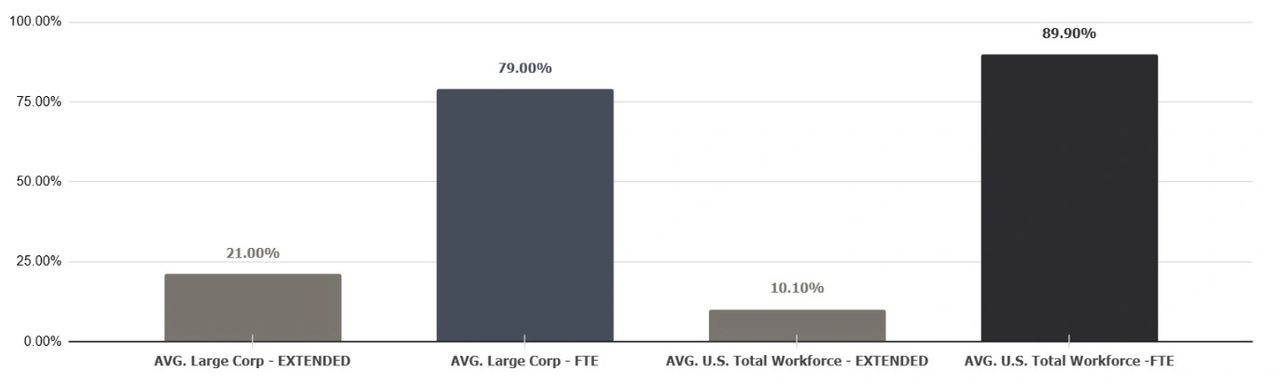
Note. Graph created by: Myriam H. Muzquiz. Data adapted from: Contingent and alternative employment arrangements, by U.S. Bureau of Labor Statistics, 2017, and Global contingent workforce 2025, by Staffing Industry Analysts, 2025.
Baseline Business Frameworks for Managing the Extended Workforce:
Clear Communication and Defined Scope
One of the most significant lessons learned is that clear, consistent, and redundant communication is non-negotiable. When dealing with an extended workforce, assumptions are the enemy because integration means success.
- Define Scope with Granular Detail: Ambiguity in project scope leads to rework and delays. In IT projects, every deliverable, dependency, and acceptance criterion must be documented with extreme precision (Schwalbe, 2019). Do you track the quality of the deliverables or the margin of error, fail/rate? Extreme resilience in operations means that timely, acceptable expectations are set at all times.
- Standardize Communication Channels: Establish primary communication tools (e.g., a specific project management platform, video conferencing, chat tools) and enforce their single point of use per your daily tasks and what you need to accomplish with the given information. There are chat spaces that are meant to be used just for certain data points, and keeping that formality gives the team insights into weekly deliverables and how they progress or compound over time, for example, week over week, is a proven method of effective tool utilization.
- Create Reusable Training Assets: Documentation isn’t just for scope; it’s for scaling knowledge. I’ve found that creating detailed Business Deck Training Materials and delivering training on workflows, quality metrics, and software adherence directly to third-party vendors ensures everyone is operating from the same playbook. Keeping a tidy library of training assets is key to operational sustainability.
- Documentation: Every decision, change, and agreement must be thoroughly documented and easily accessible. This serves as a single source of truth. There are moments when you will have to say, “Can you send this agreement to me in writing?”
Building Trust and a Unified Team
Despite the contractual nature, successful extended workforce projects thrive on trust and a sense of shared purpose. Treating external resources as mere commodities will inevitably lead to disengagement.
- Integration, not isolation: Integrate extended team members into your core project team. In a previous role, this philosophy was instrumental in growing a BDR team from 15 to 40 members, where we focused on providing career growth opportunities and a culture of promotion from within.
- Collaboration: Create an environment where external team members feel energized to collaborate, are comfortable flagging concerns, can confidently admit mistakes, and, ultimately, harness a championing movement.
- Recognize and Appreciate: Acknowledge their contributions and celebrate successes. Yes, celebrate by gift-giving, cool company swag, and, of course, if you are a team manager, strive to promote and win at team-building events that are competitive or fun – because ultimately, we are driving cohesion and celebrating at the same time.
- Cultural Sensitivity: Be mindful of cultural differences, especially with offshore teams, as this is a critical success factor in managing global IT sourcing (Carmel & Tjia, 2005). In today’s heavily globalized operation, having the intuitiveness needed to succeed and navigate relationships that are similar, different, and everything in between provides unique insights and perspectives on how a project can come together with a variety of talent. What has surprised you about working with colleagues or in projects that are vastly different than your own culture?
Robust Governance and Performance Management
While trust is vital, a strong governance framework is the backbone of controlling scope, quality, and budget. This aligns with established models for governing outsourced IT functions (Lacity & Willcocks, 2015).
- Clear Roles and Responsibilities (RACI Matrix): Implement a RACI (Responsible, Accountable, Consulted, Informed) matrix for all key tasks and deliverables. These charts are necessary, especially at the beginning of a project such as a sprint. For four weeks, you will need to bring in a special team to heavily collaborate in improving a goal; thereby, a RACI chart provides the much-needed framework for the key team members involved.
- Performance Metrics and KPIs: This is the core of my experience. In managing Salesforce operations, I’ve monitored high-volume ticketing systems and multinational sales funnels. The key takeaway is that tracking productivity metrics is the foundation of actionable governance. It allows us to move beyond simple reporting and use objective data for two purposes: first, to tell the high-level story of the operation’s overall performance; and second, to isolate the small data pieces that reveal why it’s performing that way. This creates a clear, data-driven basis for every performance review and strategic decision.
- Phased Deliverables and Milestones: Break down large projects into smaller, manageable phases with clear milestones.
- Formal Change Management Process: Establish a strict process for managing scope changes. An unvetted change is disastrous. What changed? For whom? When? What data is stored? What data will change?
Technology Enablement
Technology plays a crucial role in bridging geographical distances and facilitating collaboration, but it is merely a tool.
- Invest in Collaborative Platforms: Utilize project management software, shared document repositories, and communication tools that support real-time collaboration and transparency. These tools are essential for leading virtual and dispersed teams effectively (Malhotra et al., 2007).
- Ensure Technical Compatibility: Deploy and Immediately Verify. This isn’t just about checking for the right hardware; it’s about preventing “ghosts in the machine.” I once saw a complete system upheaval where access was mandatory to even start working. To my surprise, one user was locked out… and this wasn’t discovered for months. It’s the ultimate operational blind spot: an employee stuck in limbo, raising the immediate question, “If you can’t log in, what are you doing all day?” We can’t afford to just grant access; we must confirm it.
- Drive Software Adherence: Focus Clicks on Value, Not “Thin Air”. With twelve years of CRM experience, I’ve seen that a tool like Salesforce only becomes a central hub if you mandate focus. User acceptance hinges on perceived usefulness (Davis, 1989), but for an extended workforce, that’s not enough. We must ensure they navigate only where they will drive the most change. There are no “wasted clicks” or “click here while I think of something” sessions. Why? Because you can’t refine a process ‘out of thin air.’ You can only refine what has already been proven successful.
Empathy and Leadership
Beyond processes and tools, the success of large-scale extended workforce projects often comes down to the human element.
- Empathetic Leadership: Recognize that external teams face their own challenges and constraints. Can you see the gray area in the operation, and what does that impact look like?
- Effective Conflict Resolution: Use External Teams for “Ground Truth”. A program manager must mediate and tap into a special quality or a common denominator among extended members – they have a unique advantage vs. a direct subordinate, their position isn’t as entangled in internal politics. This gives them a unique freedom to provide honest, unbiased operational feedback—the “ground truth”—that an internal employee might be hesitant to share. A skilled PM taps into this, using that candid feedback to mediate disagreements with a focus on facts, not just internal feelings.
- Lead by Example: You Are the “Cultural Anchor” for External Teams. External members lack an FTE’s cultural immersion, meaning your actions are the company culture to them. Demonstrating a high-quality, responsive, and collaborative work ethic shows them the only way to operate on your team. You aren’t just managing a project; you are actively exporting its best cultural standards.
Conclusion
The extended workforce is a labyrinth, but it’s one we can master.
Success demands a holistic approach.
By embracing these principles, we do more than just navigate the complexity. We transform the maze of external teams into a powerful, direct path for innovation and delivering truly impactful results.
Myriam Hernández Múzquiz specializes in channel partnership strategy and operational excellence. With a background in managing large-scale CRM operations, she helps organizations build revenue-driving partner ecosystems.
Editor’s Note: This article was reviewed and refined with the assistance of Google’s Gemini.
References
Carmel, E., & Tjia, P. (2005). Offshoring information technology: Sourcing and outsourcing to a global workforce. Cambridge University Press.
Davis, F. D. (1989). Perceived usefulness, perceived ease of use, and user acceptance of information technology. MIS Quarterly, 13(3), 319–340. https://doi.org/10.2307/249008
Lacity, M. C., & Willcocks, L. P. (2015). Global information technology outsourcing: In search of business advantage. John Wiley & Sons.
Malhotra, A., Majchrzak, A., & Rosen, B. (2007). Leading virtual teams. Academy of Management Perspectives, 21(1), 60–70. https://doi.org/10.5465/amp.2007.24286164
Schwalbe, K. (2019). Information technology project management (9th ed.). Cengage Learning.
Staffing Industry Analysts. (2025). Global contingent workforce 2025. https://research.staffingindustry.com/
U.S. Bureau of Labor Statistics. (2018, June 7). Contingent and alternative employment arrangements — May 2017 [News release]. https://www.bls.gov/news.release/archives/conemp_06072018.htm