

As an IT and Operations professional focused on driving digital transformation and process optimization, I know the true cost of inefficiency. Year-end isn’t just about celebrating successes; it’s about applying Six Sigma rigor and leveraging data insights to audit our failures—especially for teams managing complex logistics and the extended workforce. Earlier this year, during my MBA program, we researched disastrous projects throughout history that were completely derailed by a lack of accountability. In this article, when we look at the most infamous project disasters, the lesson is clear: the failure to own an error early always results in an exponential cost later. Success in 2026 won’t be defined by perfection; it will be determined by the speed and integrity with which we correct our course (Senge, 1990).
Three U.S. Project Management Disasters:
When accountability is deferred, risk compounds. The catastrophic impacts of modern US projects serve as indelible warnings against letting pride or fear supersede honesty in project management. The most telling metrics in these failures are not what was budgeted, but the eventual cost of correction.
1. Boston Big Dig: The Cost of Hidden Flaws
Project Definition, Scope, and Failure:
The Central Artery/Tunnel Project (“Big Dig”) was an ambitious effort to relocate the major elevated Interstate 93 highway in Boston beneath the city, replacing it with tunnels and creating new urban parkland. The initial scope was massive, but the Original Timeline of only 7 years (starting 1985) was grossly underestimated, signaling early project management failures. The Big Dig became the most expensive public works project in U.S. history because its management failed to own up to design deficiencies and cost overruns early on. The project’s Original Estimate of $2.6 billion ultimately ballooned to $14.6 billion, an increase of 5.6 times the initial budget, fueled by years of hiding flaws (Flyvbjerg et al., 2003). Furthermore, the 7-year schedule was stretched to 15 years, resulting in an 8-year delay (Flyvbjerg et al., 2003).
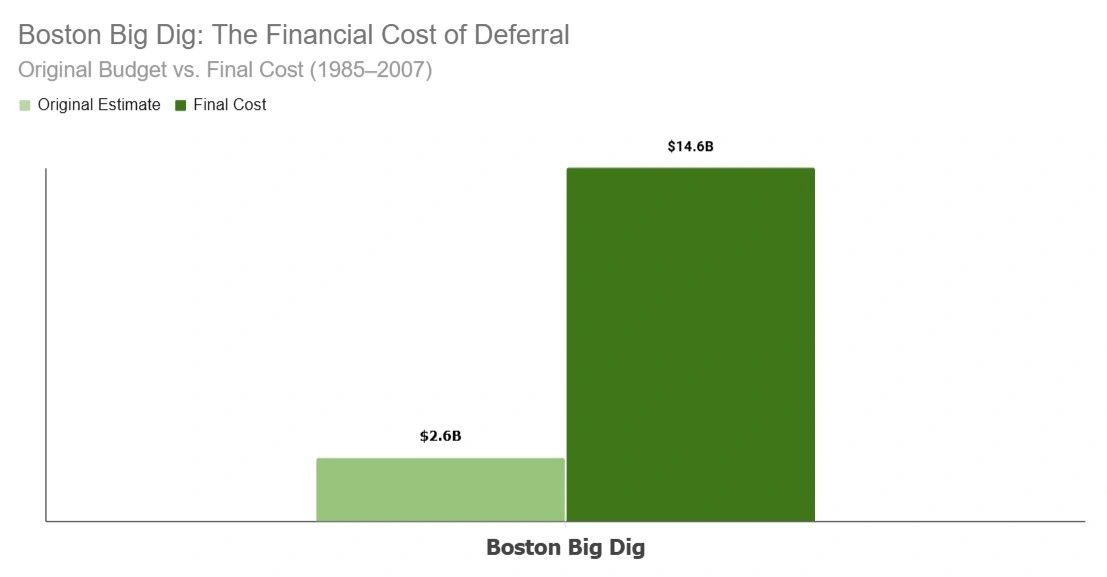
Note. Graph created by: Myriam H. Muzquiz. Data adapted from: Flyvbjerg, B., Holm, M. K. S., & Buhl, S. L. (2003). How common and how large are cost overruns in transport infrastructure projects? Transport Reviews, 23(1), 71–88; and subsequent reviews and official reports on the Central Artery/Tunnel Project.
Lesson Learned: The core lesson is that project integrity relies entirely on psychological safety (Edmondson, 1999); leaders must ensure teams can flag mistakes without fear of punishment. When this safety is absent, fear replaces accountability, allowing small errors to fester into massive, systemic failures, as starkly illustrated by the Boston Big Dig, where fear caused personnel to hide design flaws and cover up substandard work. This reluctance to report miscalculations led directly to the project’s dramatic consequences, including massive rework, catastrophic legal liability, and monumental schedule delays, proving that a project team that is afraid to speak up has fundamentally failed its most critical risk assessment.
2. California High-Speed Rail: The Cost of Scope Ambiguity
Project Definition, Scope, and Failure:
The California High-Speed Rail (CAHSR) project was conceived to link California’s major metropolitan areas, beginning with an initial segment between the Central Valley and Los Angeles/Anaheim, with trains capable of speeds exceeding 200 mph. The Original Timeline projected the full system’s completion by 2020. The CAHSR project has become a textbook example of mega-project paralysis and financial drift, showcasing how a failure to own and control scope drives costs to extreme levels. The lack of consistent political ownership and continuous changes in scope and route due to political influence caused the official estimated cost for the full system to balloon from the initial $33 billion to over $100 billion. This massive increase represents a cost overrun factor of over 3x. Furthermore, the project’s Original Timeline of 2020 has been pushed out indefinitely, with the first segment now expected in 2033 or later. This delay demonstrates how scope ambiguity allows costs to spiral uncontrollably and cripples project momentum.
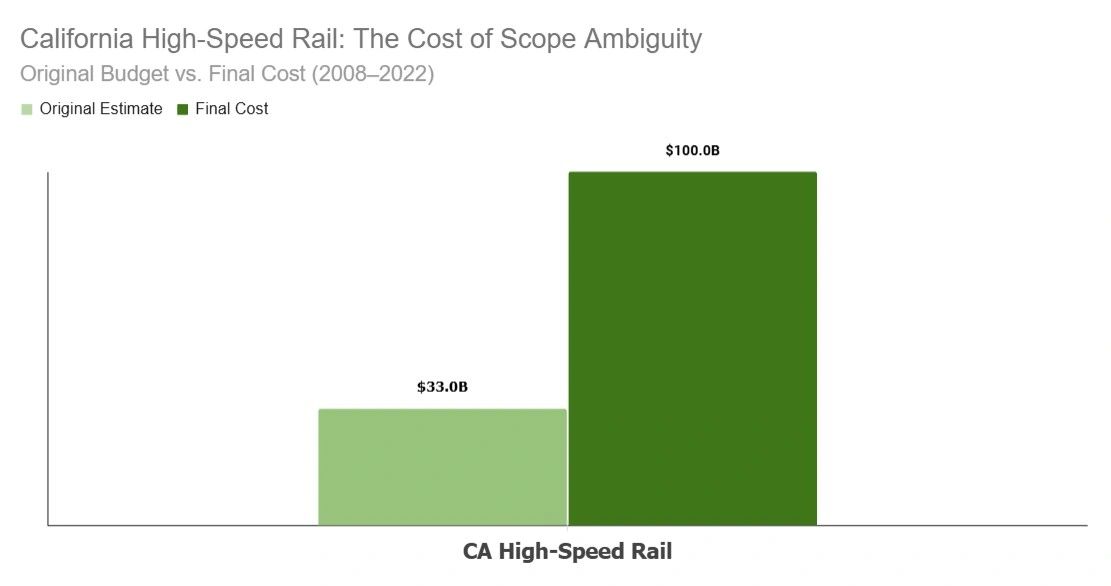
Note. Graph created by: Myriam H. Muzquiz. Data adapted from: California High-Speed Rail Authority (2022). 2022 Draft Business Plan, which documented the shift from the original $33 Billion estimate to the current $100 Billion+ projection.
Lesson Learned: Project managers must maintain rigorous scope definition and cost control. Allowing ambiguity and political influence to constantly shift the goalposts without owning the financial consequences guarantees catastrophic budget overruns. When a project lacks clear boundaries and consistent political support, management must courageously push back on changes and secure the necessary funding before proceeding. The CAHSR disaster proves that continuous scope creep—the gradual, unacknowledged expansion of project deliverables—can be just as destructive as a technical failure, draining resources and crippling project momentum. Effective ownership means drawing a firm line against changes that compromise the project’s original financial viability.
3. Healthcare.gov Rollout: The Cost of Leadership Vacuum
Project Definition, Scope, and Failure:
The Healthcare.gov project was the creation of a massive federal online marketplace designed to allow citizens to shop for and enroll in health insurance plans as mandated by the Affordable Care Act (ACA). The system was required to process complex eligibility and enrollment data across numerous state and federal systems simultaneously. The 2013 launch of the federal health insurance marketplace was a textbook failure of modern IT project management. Due to a chaotic development process involving multiple uncoordinated vendors, inadequate testing, and a profound lack of clear central ownership, the system was essentially non-functional on day one (GAO, 2015). The platform was initially expected to cost a few hundred million dollars, but the crisis forced the government to rush fixes and remediation, leading to a massive budget increase to over $2.1 billion (GAO, 2015). This failure highlights how a lack of project governance and accountability can incur a financial multiplier far greater than any physical infrastructure failure
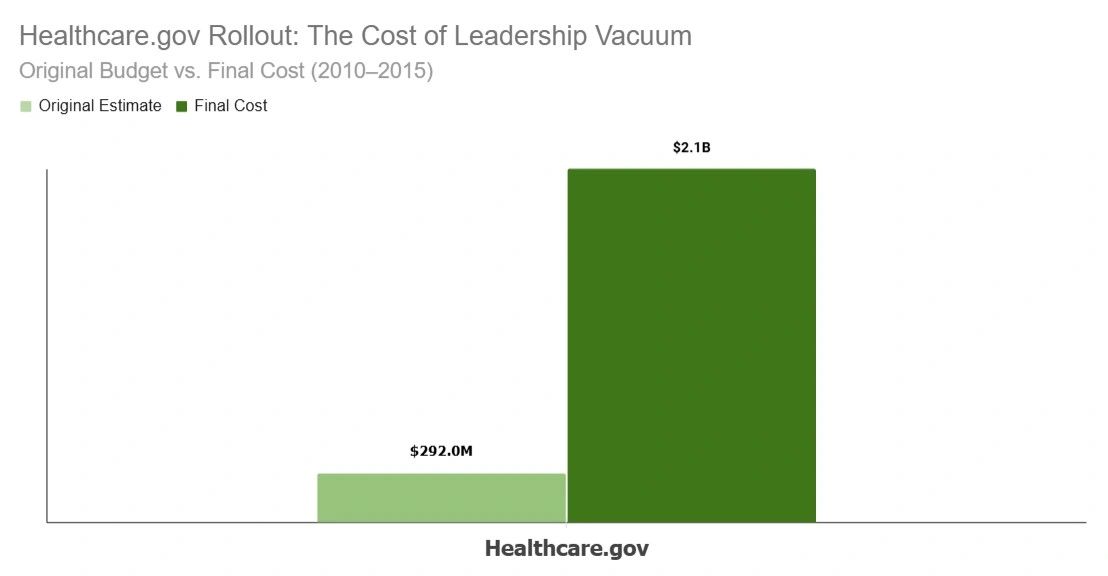
Note. Graph created by: Myriam H. Muzquiz. Data adapted from: Government Accountability Office (GAO). (2015). Healthcare.gov: CMS Has Taken Steps to Address Problems, but Needs to Further Implement System Development Best Practices (GAO-15-238), which documented the massive budget increase from initial estimates to over $2.1 billion for crisis remediation.
Lesson Learned: IT projects require rigorous governance, and a lack of central ownership will destroy success. When there is no single, accountable leader empowered to enforce standards and stop a development train heading toward failure, the project defaults to chaos. This vacuum of leadership meant that vendors were uncoordinated, and essential testing was skipped. The cost of correction when the product was rushed to meet a political deadline became exponentially higher—rising to over 7.2 times the initial estimate—than the cost of a disciplined development and testing cycle (CodeScene, 2023). Effective ownership demands courageous leaders who prioritize quality and governance over arbitrary timelines, ensuring the team’s output is functional, not just finished.
Project Management, Teamwork, and 2026
The true lesson of these historical disasters is that effective project management and teamwork are intrinsically linked to a culture of ownership. Industry data shows that an error fixed in the design phase costs 1x to repair, but that same error found in the production phase costs 30x to 100x more.
Leadership Models Vulnerability
For teamwork to thrive, leaders must model the behavior they want to see. When a project manager or executive makes a strategic misstep, it grants the entire team the necessary psychological safety to speak up about smaller operational issues. This transparency is the single greatest defense against catastrophic failure. How can you lead your team out of a misstep within the operation?
Teamwork is Risk Mitigation
The best teams treat peer review and mistake identification as a service, not an attack. When every team member sees it as their duty to own the quality of the whole project—and flag issues immediately—the cost of correction stays low, and project velocity remains high. If you look back on quality metrics and teamwork, what key moments required flagging issues immediately, and why?
Ending 2025 with Integrity
As you review your team’s performance, focus less on who made a mistake and more on how quickly and effectively it was owned and fixed. This reflection transforms failure into a fixed cost of learning rather than a compounding debt that sabotages 2026. Let’s commit to carrying this Ownership Imperative into the new year. By integrating radical honesty into our project management culture, we not only avoid becoming tomorrow’s historical case study but also ensure our teams are stronger, more resilient, and truly poised for success.
Myriam Hernández Múzquiz specializes in channel partnership strategy and operational excellence. With a background in managing large-scale CRM operations, she helps organizations build revenue-driving partner ecosystems.
Editor’s Note: This article was reviewed and refined with the assistance of Google’s Gemini.
References
CAHSR Authority. (2022). 2022 Draft Business Plan. California High-Speed Rail Authority.
CodeScene. (2023). The Business Cost of Technical Debt: Facts, Figures, and the Way Forward.
Edmondson, A. (1999). Psychological safety and learning behavior in work teams. Administrative Science Quarterly, 44(2), 350–383.
Flyvbjerg, B., Holm, M. K. S., & Buhl, S. L. (2003). How common and how large are cost overruns in transport infrastructure projects? Transport Reviews, 23(1), 71–88.
Government Accountability Office (GAO). (2015). Healthcare.gov: CMS Has Taken Steps to Address Problems, but Needs to Further Implement System Development Best Practices (GAO-15-238).
Senge, P. M. (1990). The fifth discipline: The art & practice of the learning organization. Doubleday/Currency.