

Today is Throwback Thursday on the Business Musings blog, and I find myself reflecting on one of the most intellectually stimulating—and operationally complex—projects I ever had the privilege of supporting. It was a 2022 collaboration that required balancing quantum physics and mass retail supply chains, all wrapped in a potential multi-billion-dollar market. It’s easy on TBT to celebrate the big wins, successful product launches, and signed contracts. But in consulting and strategic Go-To-Market (GTM) planning, some of the most profound lessons and growth come from the massive, “almost” deals. This particular project was one of those “almosts.”
A Hometown Collaboration with Global Stakes
The journey started when a long-time friend I’ve known since the late 90s, Roy Austin, reached out. Roy was navigating a high-stakes scenario through his company, Dispatch Tree. He invited me to collaborate on the Go-To-Market strategy for an ambitious new player in the lithium-operated portable battery sector.
The setup was incredible:
The Brains: A Global Award Winning physicist.
The Manufacturer: A high-capacity manufacturing firm located in China.
The Goal: Build a GTM model, secure certifications, and sell these sophisticated portable power stations into major big-box retailers.
My specific role was to compile the competitive landscape and the quantitative market opportunity to pitch the PhD doctor and his team in China. I was the bridge, translating raw capability and complex physics into the language of market share, CAGR, and competitive differentiation.
This week, I dug into my archives and found the presentation deck (dated July 2022) that framed our pitch. Looking back at it today, it offers a fascinating snapshot of how rapidly the clean energy sector moves.
Retrospective: What We Saw in 2022
The foundation of the pitch was built on identifying a market that was no longer “niche,” but rather an exploding consumer and commercial essential. We led with a foundational truth that was as sophisticated as the client’s team.
“Lithium was made in the first three minutes of the universe’s existence.”
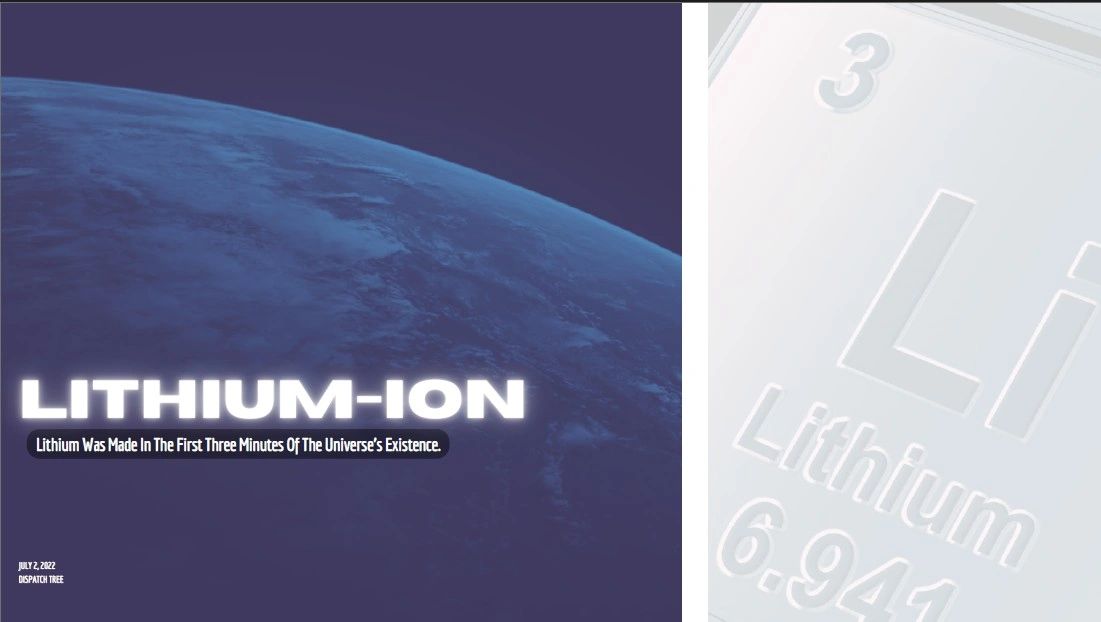
This slide established gravity. We weren’t trying to sell another plastic novelty; we were proposing that this team was uniquely positioned to harness a fundamental element of the cosmos for the “mobile-driven world.” In 2022, portable power was transitioning from specialized “prepper” gear to mainstream, “van-life” necessity.
The $41.9 Billion Guarantee
The market data from Grand View Research was staggering. In 2021, the global lithium-ion battery market was $41.9 billion. More importantly, the U.S. market was projected to have an 18.5% CAGR between 2022 and 2030.
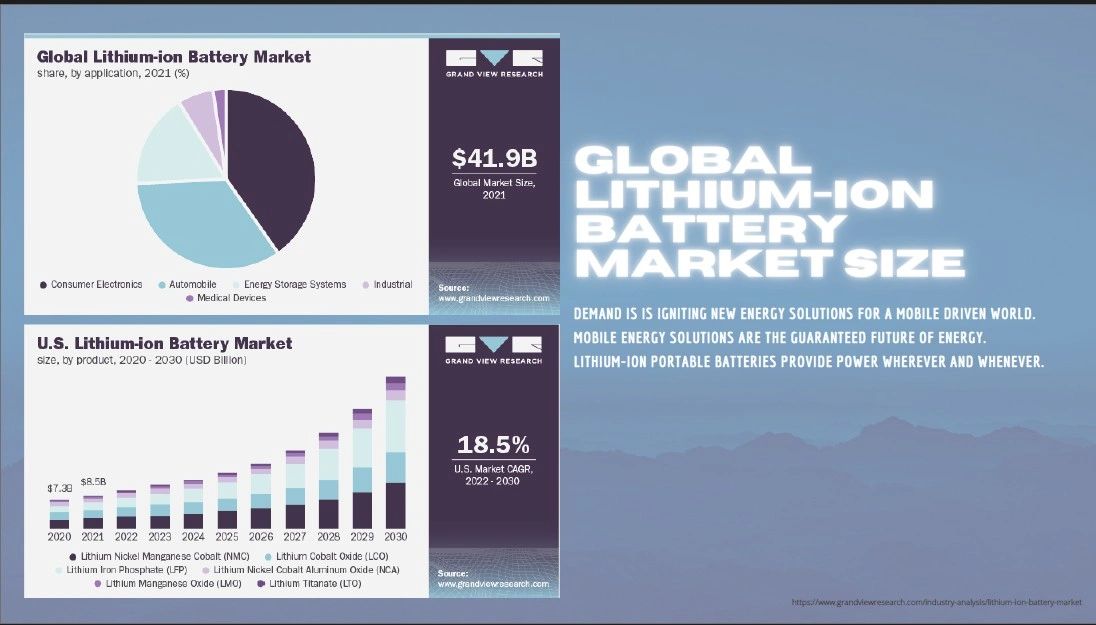
This wasn’t a speculative pitch; it was a “guaranteed future.” The market data clearly segmented where the growth was:
Consumer Electronics were dominant, but…
LFP (Lithium Iron Phosphate), noted on the U.S. segmentation chart, was emerging as the preferred technology for large portable stations due to its safety and lifecycle longevity—a key selling point for major retailers concerned with product liability.
We were framing a future of “Mobile Energy Solutions” as the guaranteed future of energy.
Additionally, (not included in the blog), our competitive analysis was deep. We weren’t just looking at battery specs; we were analyzing how brand-name companies were telling their brand story. The objective of this presentation was to convince the Pulitzer-winning physicist that excellent tech wasn’t enough; they needed to compete on lifestyle, storytelling, and retail-specific execution. Then we waited, then came the “we will see.”
2026 Check-in: The Lithium Landscape Today vs. 2022
Looking at those 2022 slides from the vantage point of March 2026, the industry hasn’t just grown—it has fundamentally transformed.
1. Market Growth vs. Massive Maturity
In 2022, the 18.5% compound annual growth rate (CAGR) felt like a “future guarantee.” By 2026, the global lithium-ion market is projected to exceed $135 billion. What we once referred to as “growth” has now become “infrastructure.” The expansion of the electric vehicle (EV) sector has normalized large-scale battery usage, making portable power stations not just for “van-lifers” but standard emergency equipment in the average suburban household.
2. Radical Price Commoditization
In 2022, a 1kWh power station was a premium investment. Today, battery pack prices have plummeted to record lows (averaging around $100/kWh globally, and even lower in some markets). The manufacturing efficiencies we discussed in the pitch have led to intense commoditization. Brand loyalty is now harder to maintain than ever, as technical specs have plateaued, forcing companies to compete almost entirely on the “lifestyle and storytelling.”
3. The “Friend-Shoring” Revolution
In 2022, our plan centered on manufacturing in China and exporting to the U.S. While that was the standard then, the 2026 landscape is dominated by supply chain resilience. Since 2022, U.S. lithium production has more than tripled. Geopolitics and “friend-shoring” policies have made the China-to-US retail path significantly more complex. The challenge we faced in 2022—balancing offshore manufacturing with American retail standards—is now the primary bottleneck for the entire industry.
The Long-Tail Value of “The Almost”
The project with Roy Austin and the PhD team didn’t end with a product on a shelf, but it ended with something more durable: Deep Market Intelligence.
As a consultant, the ROI isn’t always found in the signed contract. It’s found in the hours spent synthesizing cosmic physics into a retail pitch, the deep dives into competitive moats, and the foresight to see a $40 billion tide coming before it hits the shore.
The 2022 deck was a snapshot of a world on the brink of an energy revolution. Today, in 2026, we are living in the middle of it.
Here’s to the “almost” deals that teach us the most.
Cheers!
Myriam
References
BloombergNEF. (2025, December 9). 2025 lithium-ion battery price survey: Lithium-ion battery pack prices fall to $108 per kilowatt-hour, despite rising metal prices. https://about.bnef.com/insights/clean-transport/lithium-ion-battery-pack-prices-fall-to-108-per-kilowatt-hour-despite-rising-metal-prices-bloombergnef/
Grand View Research. (2023, April). Lithium-ion battery market size, share & trends analysis report by product (LCO, LFP, NCA, LMO, LTO, NMC), by application (Automotive, Consumer Electronics, Industrial), by region, and segment forecasts, 2023–2030. https://www.grandviewresearch.com/industry-analysis/lithium-ion-battery-market
Mordor Intelligence. (2026, February). Lithium-ion battery market size & share analysis – Growth trends & forecasts (2026–2031). https://www.mordorintelligence.com/industry-reports/lithium-ion-battery-market
Research Nester. (2026, January 6). Lithium-ion battery market size & share, growth trends 2035. https://www.researchnester.com/reports/lithium-ion-battery-market/1313
U.S. Department of Energy. (2025, September). National blueprint for lithium batteries: 2025 progress report on domestic supply chain resilience.