

We are often taught that a successful business is the sum of its parts, leading many to believe that optimizing every corner of an organization is the path to excellence. Yet, as I discovered during an extensive collaboration with Javier Arévalo of the Goldratt Group, this pursuit of total efficiency is frequently a mirage.
Meeting Javier through a mutual connection allowed us to traverse Goldratt’s theory and a fascinating range of topics, from the socio-economic pulse of Venezuela to the competitive dynamics of the Chilean market. Through these lenses, we explored the enduring power of the Theory of Constraints (TOC). Our sessions, conducted two weeks apart, distilled a 43-year-old philosophy into a modern mandate: to achieve a quantum leap, one must stop trying to make every department “shine” and instead synchronize the entire symphony around the system’s primary constraint.
Defining the Constraint: A Paradigm Shift in Productivity
At its core, the Theory of Constraints (TOC) challenges the traditional “more is better” mindset of corporate brainstorming. Our conversation centered on a provocative premise: “The more ideas you have, the more you can destroy a company,” Javier noted, echoing a strategic sentiment shared by tech giants like Jeff Bezos and former Amazon executive Jeff Wilke.
The danger lies in the surplus—introducing initiatives before the organization has the systemic capacity to absorb them. This is the heart of TOC: a philosophy that has transformed how the world’s most complex organizations, from Boeing to Delta Airlines, define success. It suggests that a company’s output is not determined by the sum of its departments, but by the strength of its single most restrictive link. To ignore the capacity levels of the company is to invite chaos under the guise of innovation.
The Origins: From Physics to “The Goal”
The narrative of TOC begins in 1983 with a physicist named Dr. Eliyahu M. Goldratt. He did not start his journey in a boardroom; he started in the logic-driven world of software. His seminal business novel, The Goal, eventually broke out of the manufacturing sector to become a mandatory “staple” on the desks of Jeff Bezos and Jeff Wilke at Amazon.
Goldratt’s genius was his refusal to view a company as a collection of parts. Instead, he treated the organization as a scientific system—a complex chain of interdependencies. He recognized a fundamental mathematical truth: a chain is only as strong as its weakest link. If you improve every link by 10%, the total strength of the chain remains stagnant. However, if you identify that one “weak link” and strengthen it, the entire system undergoes a quantum leap in performance.
Conceptualizing the Constraint: Beyond the Bottleneck
During our discussion, Javier was quick to dismantle a pervasive industry myth. “Everyone has constraints,” he clarified, “but not everyone has a bottleneck.”
The distinction is critical for any leadership team to understand:
- A Bottleneck is a tactical resource that cannot satisfy demand—the classic “slow machine” on a factory floor.
- A Constraint is far more insidious. It is anything that limits the system from achieving its goal, whether it be a legacy policy, a lack of market demand, or a fundamental flaw in the CEO’s strategy.
To illustrate this, Javier introduced a powerful metaphor. “Think of a symphony,” he explained. “Not everyone gets a solo. If every musician tries to play as loud and fast as possible to ‘shine’ in their own space, you don’t get music; you get noise.”
In the corporate world, these individual “solos” are Functional Silos. When departments obsess over localized KPIs without synchronizing with the whole, the organization’s “composition”—its collective output—suffers. Success, therefore, is not about individual brilliance; it is about the Symphony of Synchronization.
The Core Logic: The Five Focusing Steps
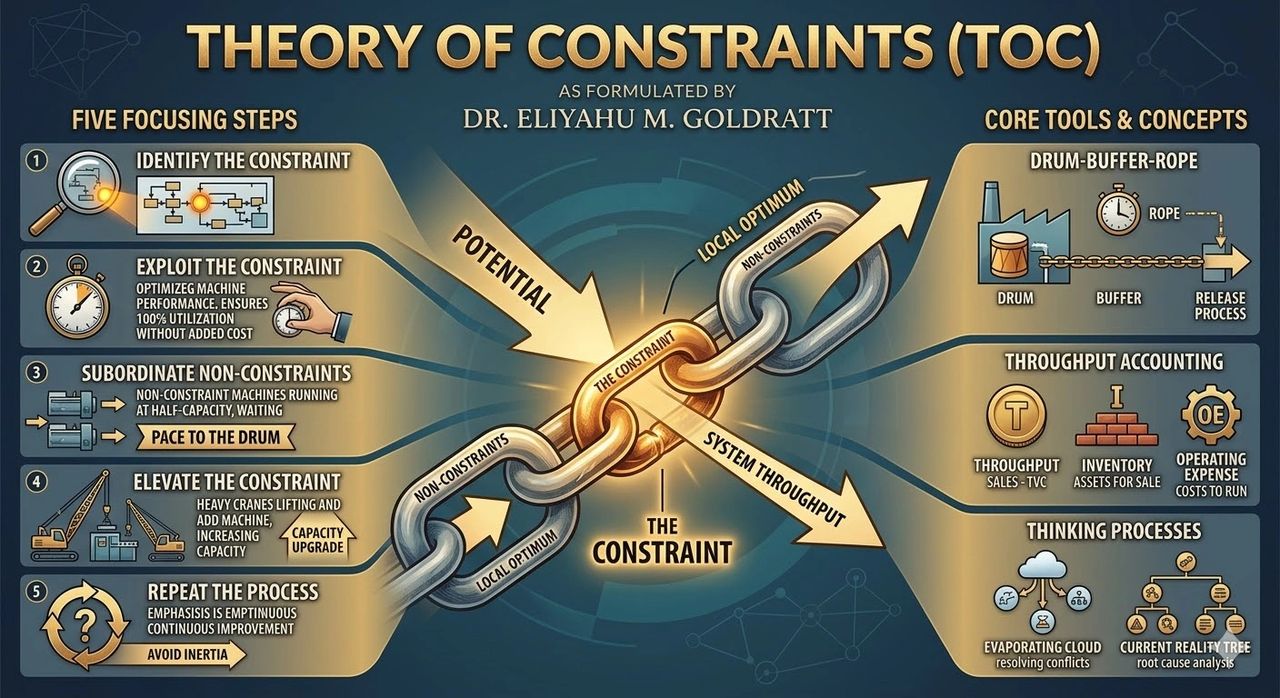
To transition from “noise” to “symphony,” the Goldratt Group employs a disciplined, five-step methodology designed to synchronize the entire organization around its primary constraint:
- Identify the Constraint: Locate the weakest link. Crucially, this is rarely just a physical asset; it is often found within the CEO’s overarching strategy or a legacy policy.
- Exploit the Constraint: Before spending a single dollar on new resources, ensure the existing constraint is not wasting time on non-critical tasks. Maximize the current capacity.
- Subordinate Everything Else: This is the most psychologically challenging step for leadership. It requires other departments to “slow down” or adjust their pace to stay in perfect synchronization with the constraint. This is the end of the “solo” performance.
- Elevate the Constraint: Only after steps 2 and 3 are exhausted do you invest in more capacity. You are now strengthening the link that actually moves the needle.
- Repeat: Do not allow institutional inertia to set in. Once the link is strengthened, the constraint will move. The process begins again to find the new weakest link.
The Strategy Bottleneck: From Boardrooms to Battlefields
Javier identifies a sobering reality for many leadership teams: the ultimate constraint is often a void of strategy. “Strategy is deciding which market I will inhabit, which I will exit, and which I will ramp up,” he notes. While many organizations obsess over cost-cutting, Javier argues that sustainable cost savings are merely a consequence of a sound strategy—never the strategy itself.
This is where we move from the hypothetical to the reality of global operations. Consider the Goldratt Group’s work with the U.S. Marines and Delta Airlines. For over 20 years, they have partnered with Delta on Maintenance, Repair, and Overhaul (MRO). By identifying the singular weak link—whether it was a flaw in parts distribution or a bottleneck in pilot training—they achieved operational turnarounds that appeared, to the untrained eye, to be impossible.
In these high-stakes environments, finding the constraint isn’t just about efficiency; it’s about the mission’s success.
The 90-Day Turnaround: Escaping the Benchmarking Trap
One of the most provocative insights from our conversation centered on a sacred cow of corporate consulting: Benchmarking.
“Benchmarking guarantees you will be #2,” Javier warned. “Looking at what the ‘best’ are doing only helps you copy them. You don’t need to look at competitors; you need to look at your own system.”
In an era where organizations chase marginal gains, the Goldratt Method targets a 90-day turnaround. By shifting the focus away from competitors and toward the internal “weak link,” improvements cease to be incremental (the standard 1% or 3% gains) and instead become exponential. Like Alex, the beleaguered plant manager in The Goal, modern leaders are discovering that once they stop rewarding individual “siloed” brilliance and start prioritizing systemic synchronization, the entire company achieves a Quantum Leap in performance.
The Human Element: Solving the Thinking Constraints
If the logic of TOC is so sound, why isn’t it the universal standard? The answer lies in Human Constraints. Organizational “Silos” do not exist by accident; they are maintained because individuals have an innate need to feel productive. Unfortunately, modern KPIs are almost exclusively designed to reward this local performance rather than global throughput. When we incentivize the “solo,” we inadvertently sabotage the symphony.
To resolve these deep-seated conflicts, Javier utilizes TOC’s “Thinking Processes”—a set of logical tools designed to expose the hidden assumptions that keep companies stuck. It requires a fundamental shift in mindset: moving away from a linear, fragmented view of business and accepting that the world functions as a non-linear, holistic system of interdependencies.
Growth is not a matter of working harder; it is a matter of thinking systematically.
Conclusion: The Throughput Mindset
As our three-hour intensive drew to a close, the mandate for modern leadership became clear: sustainable growth is not a byproduct of doing more. It is the result of doing the right thing at the right time. If you are a leader currently overwhelmed by 100 competing initiatives, I encourage you to heed Javier’s advice: identify your symphony’s constraint. Stop the solos. Synchronize your efforts. Focus relentlessly on the weak link.
The quantum leap is waiting.
— Myriam H. Muzquiz, MBA
A Strategic Post-Scriptum Business Exercise: 📝
Javier, our discussion regarding the “Grocery Store Paradox” stayed with me. We looked at a scenario common to us all: a store with 20 checkout lines, yet only five are operational, resulting in a 20-minute queue. To the traditional manager, those 15 closed lines represent “saved labor.” But when we apply the Theory of Constraints (TOC) logic, we see that the Unitary Cost of opening 10 lines is actually an investment in Systemic Throughput.
The Mathematical Proof 🧮
In our exercise, we shifted the focus from Local Labor Optimization to Global Throughput Velocity:
1. The Throughput Velocity Formula ⚡
To understand the true health of the store, we must measure the rate at which the system clears its “Inventory” (the customers):
Throughput Velocity = Total Sales Value ÷ Time to Clear Queue 🛍️
By doubling the active capacity, we don’t just cut the wait in half; we exponentially reduce the Operating Expense (OE) associated with keeping the facility powered and staffed while a slow queue stagnates.
2. The Cost of the Idle Constraint ⏳
As we discussed, an hour lost at the bottleneck is an hour lost for the entire system. If the checkout is the constraint, the true cost of that 20-minute wait is:
Cost of Constraint Idle Time = Total Operating Expense of Store ÷ Total Operating Hours
Every minute those five lines are backed up, the entire store’s overhead—rent, electricity, insurance—is being “paid for” by a restricted, slower drip of revenue. 💸
Solution: Opening 10 lines allows the store to reach its “Goal” faster. We reduce utility consumption, eliminate “customer churn” from abandoned carts, and ensure the team exits on time. The Constraint wasn’t the number of cashiers; it was the Policy that prioritized local labor savings over global flow. ✅
Recommended Reading:
The Goal by Eliyahu M. Goldratt
Eliyahu M. Goldratt’s: GOAL A BUSINESS GRAPHIC NOVEL
As an Amazon Associate, I earn from qualifying purchases.
Recommended Video:
Jeff Bezos discusses how Jeff Wilke taught him that even great ideas can destroy a company if they exceed the system’s capacity.
This article was developed with the creative and editorial support of Gemini, an adaptive AI collaborator by Google, ensuring the precision of data and the clarity of the Theory of Constraints methodology.